
Products › Roof & Facade Underlays and Vapour Barriers › TrioTex X Fire
TrioTex X Fire
Fire-retardant breathable facade underlay.
Request submittal, sample or priceBack to Roof & Facade Underlays and Vapour Barriers
Page text
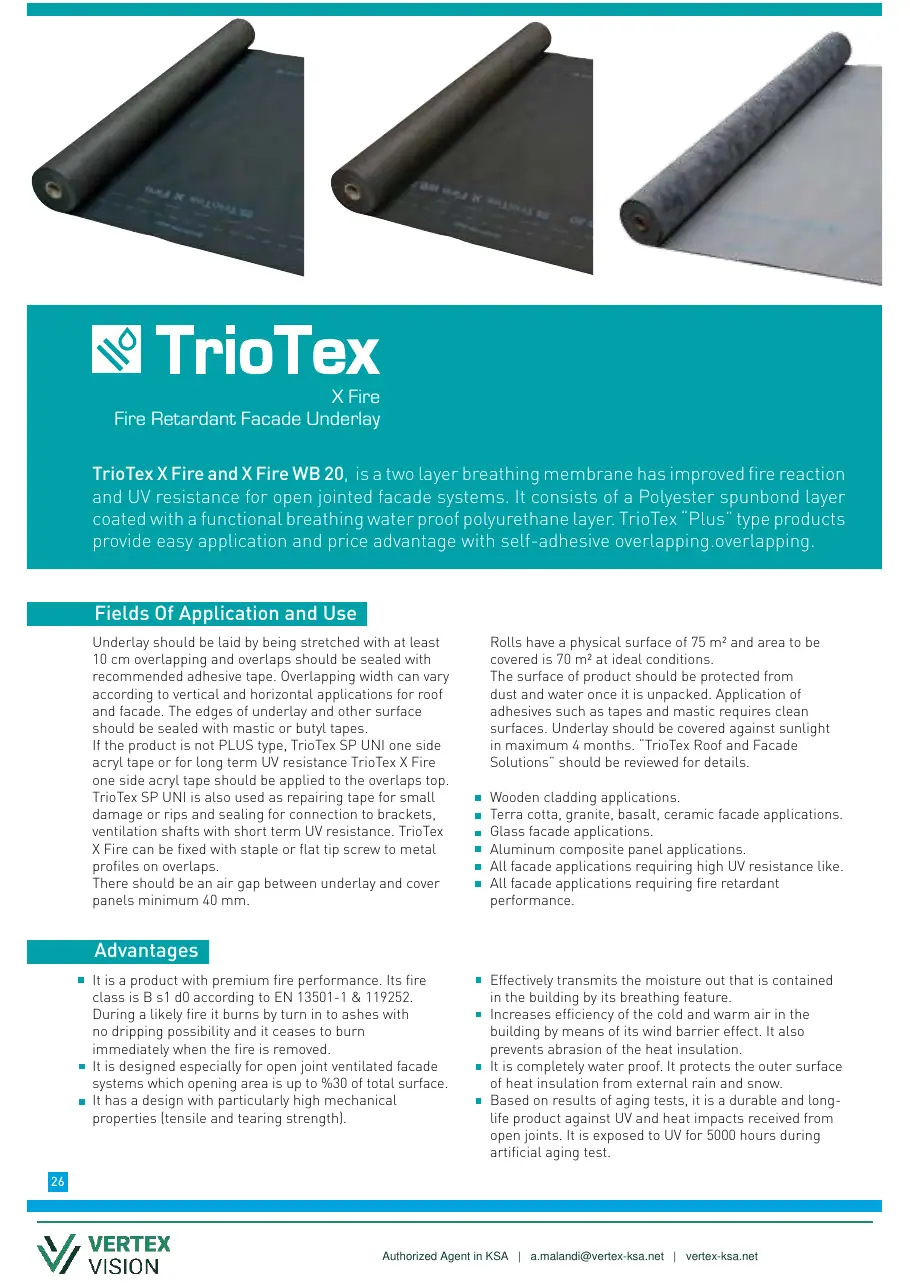
X Fire Fire Retardant Facade Underlay TrioTex X Fire and X Fire WB 20, is a two layer breathing membrane has improved fire reaction and UV resistance for open jointed facade systems. It consists of a Polyester spunbond layer coated with a functional breathing water proof polyurethane layer. TrioTex “Plus” type products provide easy application and price advantage with self-adhesive overlapping.overlapping. Fields Of Application and Use Underlay should be laid by being stretched with at least Rolls have a physical surface of 75 m² and area to be 10 cm overlapping and overlaps should be sealed with covered is 70 m² at ideal conditions. recommended adhesive tape. Overlapping width can vary The surface of product should be protected from according to vertical and horizontal applications for roof dust and water once it is unpacked. Application of and facade. The edges of underlay and other surface adhesives such as tapes and mastic requires clean should be sealed with mastic or butyl tapes. surfaces. Underlay should be covered against sunlight If the product is not PLUS type, TrioTex SP UNI one side in maximum 4 months. “TrioTex Roof and Facade acryl tape or for long term UV resistance TrioTex X Fire Solutions” should be reviewed for details. one side acryl tape should be applied to the overlaps top. TrioTex SP UNI is also used as repairing tape for small Wooden cladding applications. damage or rips and sealing for connection to brackets, Terra cotta, granite, basalt, ceramic facade applications. ventilation shafts with short term UV resistance. TrioTex Glass facade applications. X Fire can be fixed with staple or flat tip screw to metal Aluminum composite panel applications. profiles on overlaps. All facade applications requiring high UV resistance like. There should be an air gap between underlay and cover All facade applications requiring fire retardant panels minimum 40 mm. performance. Advantages It is a product with premium fire performance. Its fire Effectively transmits the moisture out that is contained class is B s1 d0 according to EN 13501-1 & 119252. in the building by its breathing feature. During a likely fire it burns by turn in to ashes with Increases efficiency of the cold and warm air in the no dripping possibility and it ceases to burn building by means of its wind barrier effect. It also immediately when the fire is removed. prevents abrasion of the heat insulation. It is designed especially for open joint ventilated facade It is completely water proof. It protects the outer surface systems which opening area is up to %30 of total surface. of heat insulation from external rain and snow. It has a design with particularly high mechanical Based on results of aging tests, it is a durable and long- properties (tensile and tearing strength). life product against UV and heat impacts received from open joints. It is exposed to UV for 5000 hours during artificial aging test. 26
Page text
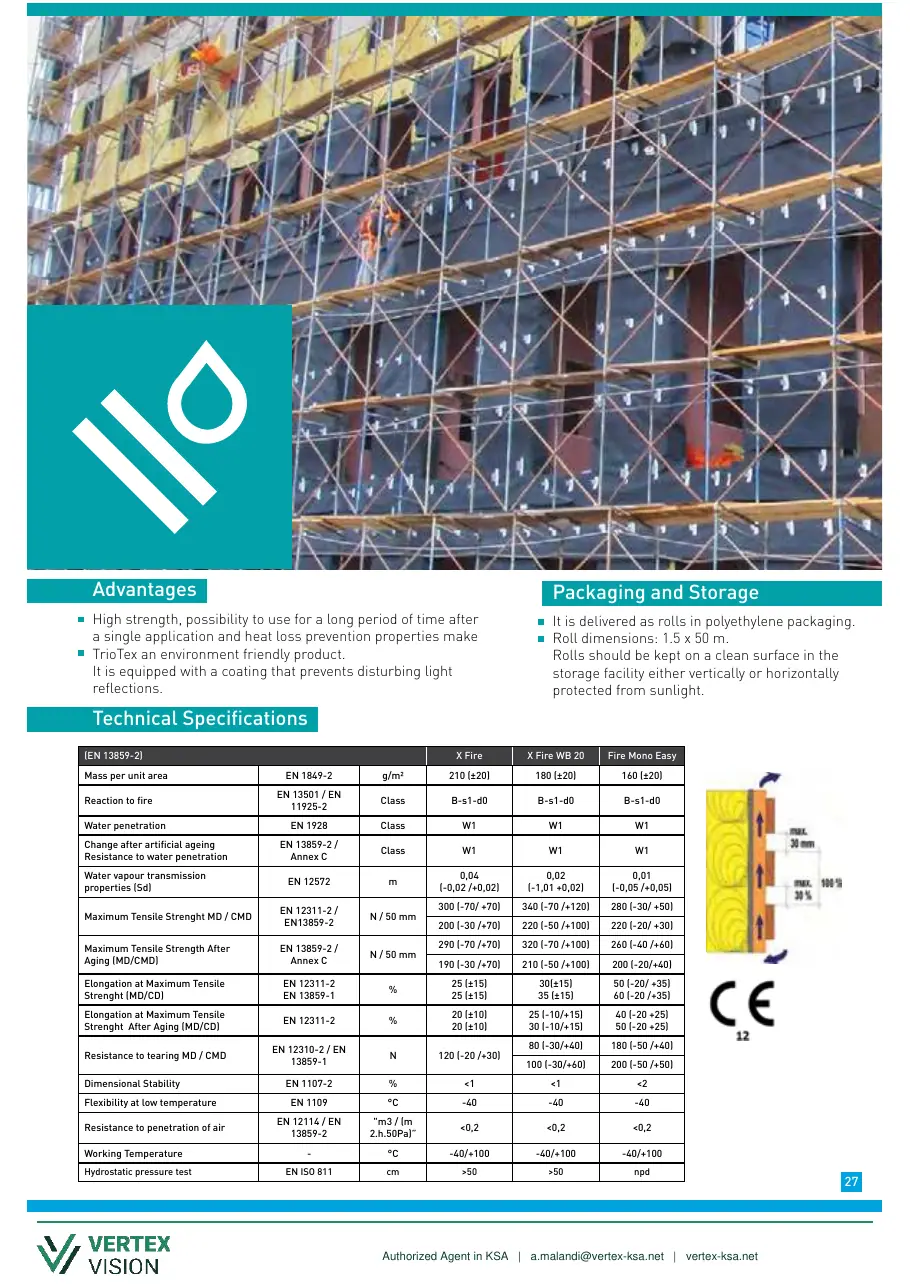
Advantages Packaging and Storage High strength, possibility to use for a long period of time after It is delivered as rolls in polyethylene packaging. a single application and heat loss prevention properties make Roll dimensions: 1.5 x 50 m. TrioTex an environment friendly product. Rolls should be kept on a clean surface in the It is equipped with a coating that prevents disturbing light storage facility either vertically or horizontally reflections. protected from sunlight. Technical Specifications (EN 13859-2) X Fire X Fire WB 20 Fire Mono Easy Mass per unit area EN 1849-2 g/m² 210 (±20) 180 (±20) 160 (±20) EN 13501 / EN Reaction to fire Class B-s1-d0 B-s1-d0 B-s1-d0 11925-2 Water penetration EN 1928 Class W1 W1 W1 Change after artificial ageing EN 13859-2 / Class W1 W1 W1 Resistance to water penetration Annex C Water vapour transmission 0,04 0,02 0,01 EN 12572 m properties (Sd) (-0,02 /+0,02) (-1,01 +0,02) (-0,05 /+0,05) EN 12311-2 / 300 (-70/ +70) 340 (-70 /+120) 280 (-30/ +50) Maximum Tensile Strenght MD / CMD N / 50 mm EN13859-2 200 (-30 /+70) 220 (-50 /+100) 220 (-20/ +30) Maximum Tensile Strength After EN 13859-2 / 290 (-70 /+70) 320 (-70 /+100) 260 (-40 /+60) N / 50 mm Aging (MD/CMD) Annex C 190 (-30 /+70) 210 (-50 /+100) 200 (-20/+40) Elongation at Maximum Tensile EN 12311-2 25 (±15) 30(±15) 50 (-20/ +35) % Strenght (MD/CD) EN 13859-1 25 (±15) 35 (±15) 60 (-20 /+35) Elongation at Maximum Tensile 20 (±10) 25 (-10/+15) 40 (-20 +25) EN 12311-2 % Strenght After Aging (MD/CD) 20 (±10) 30 (-10/+15) 50 (-20 +25) EN 12310-2 / EN 80 (-30/+40) 180 (-50 /+40) Resistance to tearing MD / CMD N 120 (-20 /+30) 13859-1 100 (-30/+60) 200 (-50 /+50) Dimensional Stability EN 1107-2 % <1 <1 <2 Flexibility at low temperature EN 1109 °C -40 -40 -40 EN 12114 / EN "m3 / (m Resistance to penetration of air <0,2 <0,2 <0,2 13859-2 2.h.50Pa)” Working Temperature - °C -40/+100 -40/+100 -40/+100 Hydrostatic pressure test EN ISO 811 cm >50 >50 npd 27